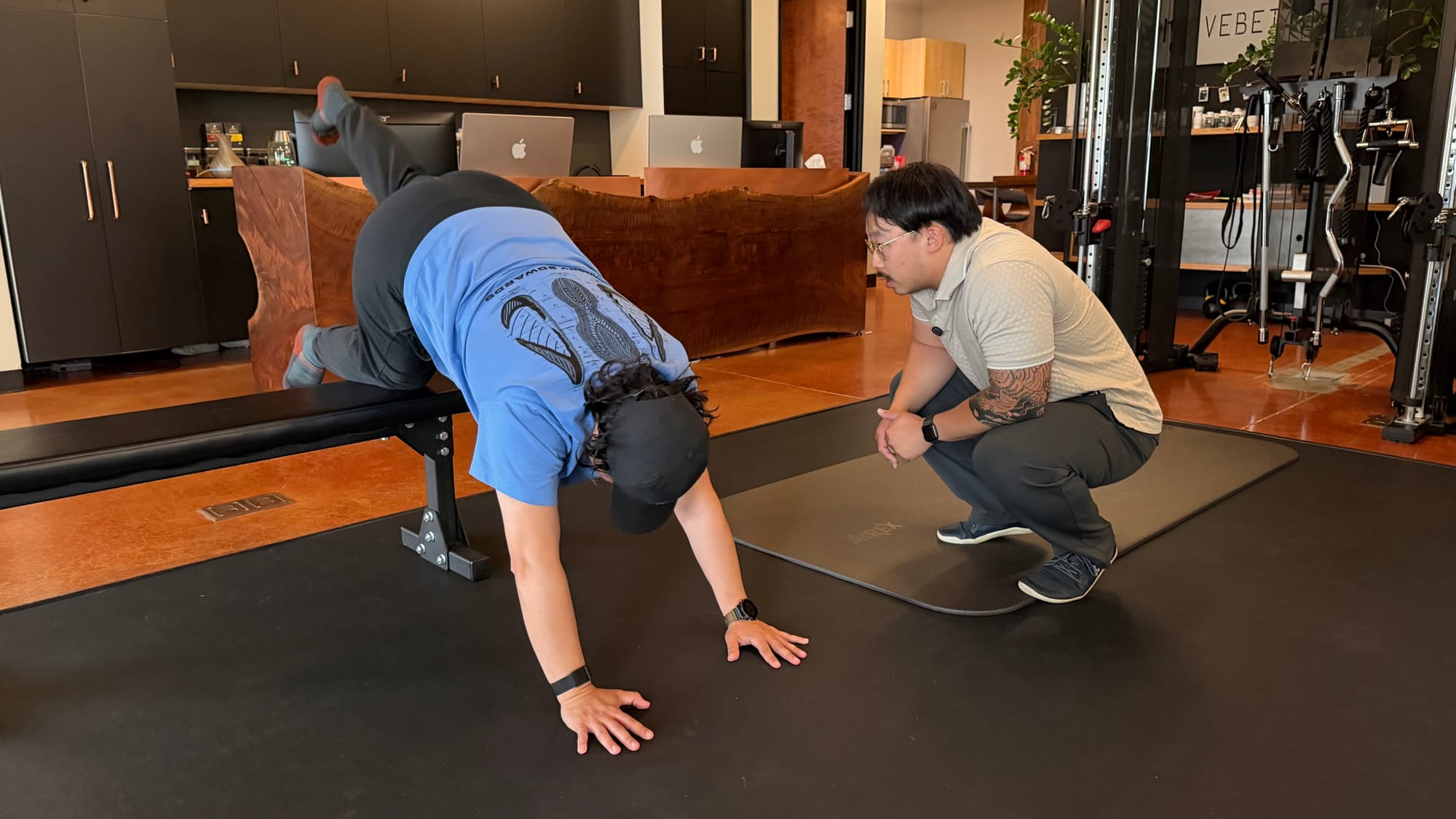
The first question I ask them is are they competing soon, or how many weeks out are they from competing? Is this a goal that has to happen soon — whether it’s because it’s a race that you can’t push back, or is this like a personal goal that you have? That’s the first thing I ask.
My background is Olympic weightlifting, so this isn’t theoretical for me. If I’m six weeks out from a competition, I personally felt like I could still take a rest day or two and it won’t hinder my training ability. If I’m two weeks out, it’s just a pain cave — and sometimes you do have to push through. It’s so close, you’re almost there. Unless you feel like you’re going to injure something. If you feel like you’re going to injure something, then yes, relax. That’s the time to do a lot of body work. But if you’re feeling slightly off — a little bit of back discomfort, a little bit of knee pain, whatever it is — two weeks out, three weeks out, and the competition is something you’re flying out for, maybe it’s American Open finals, maybe it’s your first National meet, maybe it’s a marathon that you signed up and paid for, that’s when you continue and push.
The Warm-Up Is My Diagnostic Tool
The warm-up is going to be the most telling thing for me. The warm-up tells me how the day is going to go, and I can modify from the warm-up alone. Even just touching the bar — if I feel good, I’m CAN push it. Just because it feels good, does not mean you have to push it. But don’t be afraid to tell your coaches or listen to your body. If you feel like you can’t push it, don’t push it. You need to make sure that you communicate with coaches, trainers, whoever. And that’s where having a team — massage therapists, chiropractors, PTs, people like the team at Move Better — comes in handy. We can help get you to the finish line, through the finish line, identify certain things that you can add to your warm-ups.
For me, each bit of my warm-up was a diagnostic tool. There were always three exercises I chose — some sort of hinging pattern, an overhead stability pattern, and a squat with just an unloaded barbell. My back was the thing that would always bother me, especially right-sided low back pain. There were days where I tried to push through training and if I tried to pick up a barbell, my body would just make me drop the barbell.
The three biggest things for me were: core — making sure I could really feel what I wanted to feel, my squat pattern, and an overhead pattern. The biggest tells were the squat and the core warm-up. If I couldn’t get those right, I knew my training was going to feel bad. In that case, I’d bring it up with my coach and we’d modify. Instead of doing full snatches, I’d do snatch from the blocks — or even just a 2-inch block underneath so I didn’t do a full snatch. Squats, I’d switch from back squats to front squats, because front squats I could load properly and I never had issues with them. We’d change the pulls that day — say clean lifts or clean pulls — then switch to no pulls and just extra accessories, extra core, and we’d try to fit those pulls in a different day.
It Always Came Back to Stress
What actually drove that right-sided low back pain? It varied. Stress was a big factor. Also how I slept, my nutrition, hydration. But it always came back down to stress.
I tell patients about my own experience and how there are too many outside factors to not affect your training. You cannot neglect mental health while training. You have to be aware, and understand that it’s okay to take your foot off the gas pedal. Strenuous days at work will definitely affect how you train. Fights with partners. Fights with family. Serious life events. A deadline at work. Things like that can really affect training. There’s a real, well-documented link between psychological stress and musculoskeletal pain — it’s not in your head, it’s in your nervous system.
When There’s Nothing on The Calendar
The principles are similar for patients who aren’t chasing a specific competition date, but the conversation changes. If there’s no hard deadline, then I can really spend the time to sit down and plan it out. Taking the stress off of having a timeline can be helpful, and it allows us to really focus on what is causing them pain. We have time to break that pattern.
And the insight that surprises a lot of athletes: it’s okay to not push hard all the time. In all training — lifting or running — you need to have a deload week, or a deload in general. Your body needs time to recover, and deloads are a great way to do that.
What a Deload Actually Looks Like
A deload depends on what we’re doing and the timing of where we are in our lifting cycle, or training day. Is it the middle of a session, middle of a competition prep? Then you’d reduce volume and intensity. You’d still go in the gym and do certain lifts, but maybe add a little bit of variety, or just reduce volume and intensity. Instead of doing 90% snatch complexes, you’d drop down to 60%. Instead of four to five working sets, you’d drop down to maybe two to three. Try to keep it quick, keep it moving, and work on the things you wanted to work on. Making sure sleep and nutrition is on point.
After a competition is the most important time for me. You’re all done — you need to take time away. In that time away, you can go into the gym and lift, but don’t do any snatches and clean and jerks. I find that’s a surefire way for a lot of people to burn out — or have a higher potential of burning out.
My only regret from competing is I didn’t take enough time away after competitions. I would always jump back into it, and I wish I’d taken two or three weeks away from the barbell — classic Olympic lifting, snatching, clean and jerking — and spent more time doing things I hadn’t done in a while and having fun with it. Then going back into it slowly, and spacing out competitions. Having competitions too close to each other put so much stress and load onto my body that made me burn out quicker than the previous competition prep.
Why Move Better
All the practitioners here train in one sport or another, or have trained in multiple sports. We understand that the answer is never stopping the sport. We’re going to find ways to work through it and figure out the best way to support you before your big race, big competition.
If you’ve got something on the calendar — or you just want someone in your corner who actually understands the pull between pushing and recovering — come see us.
— Dr. Tyler, Move Better, Portland, OR