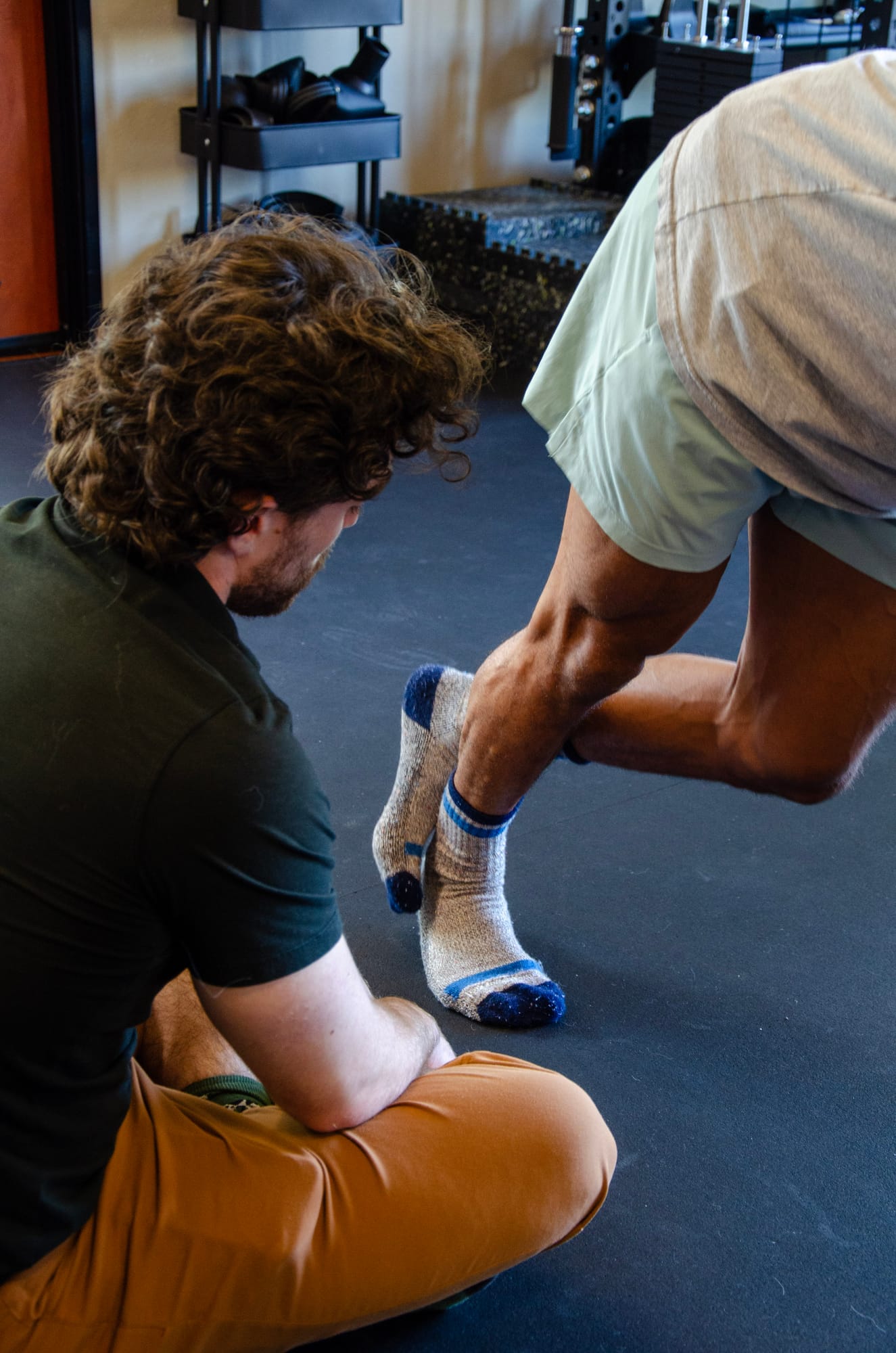
The barefoot-vs-orthotic debate is the wrong debate
At Move Better in Portland, we don’t have a fixed answer on barefoot versus orthotics. It’s very patient-specific and it’s very individualized.
We’ve had patients with a history of wearing really supportive shoes — Hokas, lots of insoles, lots of arch support, very soft bottoms to absorb impact — respond really well by switching to a barefoot shoe and working on stabilization of the foot and ankle through exercises and movement patterns in a barefoot context. And we’ve seen the other side of the spectrum: patients wearing barefoot shoes, lifting and exercising barefoot, experiencing pain or discomfort after prolonged walks or running, and responding really positively to going to a podiatrist for an orthotic consult and having a custom insole made for their shoes.
So instead of a black-or-white approach where one camp is right and the other is wrong, we’re focused on understanding the benefits and drawbacks of both and constructing an individualized plan for each patient — one that is ultimately driven by the patient’s subjective experience.
What orthotics actually do (and what they don’t)
The biggest misconception patients bring in about orthotics is that it’s a passive way of creating the structural change within the foot that would ideally improve the alignment of the foot, ankle, knee, and hip. And while an orthotic can alleviate symptoms, it’s not getting to the root cause of the issue — which is that the patient does not have the ability to properly stabilize their foot.
The patient really needs to understand how to create the shape, create the stability, and create the co-contraction of the muscles in the foot that leads to symptom alleviation on their own — and not depend on the shoe.
That said, orthotics have a place. If someone is a marathon runner and their goal is to run a marathon, it could be taking away from that big overarching goal if the bottleneck is, well, you can’t run longer distances than your ability to maintain this position in your foot. If you wear an orthotic, you’re getting the benefit of passively stabilizing the foot, but that’s at the cost of not actively stabilizing it in the way that would let you create that stability within your own body. That trade-off is okay — as long as you’re padding it with other movements, exercises, or intentional time set aside to actively address it alongside the passive support.
Foot pain usually isn’t a foot problem
When patients come in with foot pain, most of them are very focally present with how the foot is feeling. It’s intuitive — if your foot hurts, you stretch and mobilize your foot. But what we commonly see is that you can treat foot pain and ankle pain by going up the chain — looking at what’s happening at the knee, at the hip, and at how the patient is stabilizing their pelvis.
If someone has foot discomfort, we’re immediately going upstream and making sure everything in the midline of the body is adequately stabilizing. If it’s not, a pelvis compensation or an unfavorable movement pattern upstream can change how a patient is loading into their foot. (This is the same principle we’ve written about in why plantar fasciitis involves more than just your foot.)
A recent case: medial arch pain that lived in the hip
We had a patient recently with foot pain in the medial arch region of their left foot. They had tried rolling out the foot with a massage gun and a lacrosse ball, stretching their calves, doing calf raises, doing short foot exercises to strengthen the medial arch. Nothing was giving them symptom relief.
The first thing we did was have them just stand and naturally position their body. What we saw was a pes cavus — a collapse of the medial arch — with a knee valgus, and tightness and restriction upon palpation within the external rotators of the hip.
Here’s the compensation we see all the time: a patient is limited in internal rotation of their hip, or unstable when a movement requires internal rotation. To mimic what hip internal rotation would deliver, the body lets the knee collapse toward the inside and the medial arch collapse — bringing the leg toward the midline to accommodate the limitation upstream.
We had this patient work on activation and stabilization through hip internal rotation on their left side, which was more limited than the right. We worked in a 90-90 position, focusing on isometric activation of internal rotation. Then we progressed to a 90-90 get-up and hip extension from that position, so the patient was owning and stabilizing that mobility in a more functional application.
Lo and behold — when we re-observed their standing posture after improving left hip internal rotation, the collapse of the medial arch on their left foot was reduced. Exclusively by working on hip stabilization and internal rotation mobility.
Making the patient the experiment
From there, more important than the prescribed 90-90 exercises was a conversation about how their gait was being affected by the hip restriction. We asked them to run an experiment: go on a long walk, don’t warm up, don’t stretch, just observe what you feel in your foot. Then, a couple of days later, go on another walk — but first mobilize and activate your left hip through internal rotation. Observe if you feel any differences in your foot after improving the stability and mobility upstream.
They reported back that after the rehab work, they felt a more even distribution of weight through their foot and less collapse toward the medial side as they walked.
Foot pain recovery is usually an uphill battle
Working with foot pain is on average a longer recovery than other areas, because unless someone completely immobilizes themselves and lays in bed for two weeks — which creates its own problems — you’re not able to completely offload and rest the area. You’re fighting an uphill battle: trying to rehab and restore proper function while also consistently running into overuse.
This patient had a pretty immediate positive response, but after that initial 50% reduction in symptoms, the following four to six weeks kind of lingered — a slow and arduous process. By the six-week mark, they were reporting 85 to 90% improvement, and their symptoms were much more manageable when they did the prep work before any activity that had historically caused problems.
Who we see with foot pain in Portland
The two groups we see most often are runners and previously inactive people who are ramping up activity.
It’s a volume game. If someone has underlying biomechanical compensations but isn’t exposing their body to enough stimulus to trigger pain or inflammation, the compensations can lie dormant for a really long time. With runners, the compensation manifests repetitively because of the volume they spend on their feet and the impact they receive with every step.
With people who are heavier and starting to engage with exercise in a way they’re not used to, there’s the possible compensation piece — but there’s also just an adaptation process. Your feet and ankles are structurally adapted to withstand a certain amount of impact, and now you’re significantly increasing that in a very short period of time. Your body might just need time to adapt, regardless of whether there’s a compensation happening upstream.
When it’s not a movement problem
There are red flags where a movement-first approach isn’t the right first step: neurological compromise — numbness, tingling, complete loss of muscular function or sensation in an extremity — and significant structural injury like a fracture.
The picture of a fractured foot is very different from chronic muscular, ligamentous, or joint irritation. The archetype is: “I was playing soccer, I lost my balance, my foot flicked underneath my ankle, I heard a crack, it’s super black and blue and swollen, and I can’t put any weight on it.” If a patient is giving us that description, we’re pivoting immediately — working above the kinetic chain if we can, but mostly educating and referring for imaging.
If imaging confirms a fracture, we refer for an orthopedic consult and let the surgeon decide whether it needs to be casted or whether it’s insignificant enough to let the swelling dissipate and the bone fuse. From there, it’s managing inflammation — ice, elevation, compression, topical anti-inflammatories like diclofenac, and if it’s really bad, oral NSAIDs — and slowly, incrementally building the patient back up.
That progression looks like: isometric contractions of the foot in different planes to pain tolerance → concentric and eccentric contractions of isolated ankle motion → single-leg balance with the whole kinetic chain involved → hinging and single-leg squat variations → impact control like drop steps and box jumps → dynamic movements like lateral jumps, skip steps, and integrating running. The bottleneck is always the patient’s symptoms. With an acute injury, we’re not chasing 0% pain — we’re using a 2–3 out of 10 as the yellow flag that tells us whether to keep pushing or let the body acclimate.
What we tell patients who’ve already tried everything
If you’ve already seen other providers for foot pain and haven’t found lasting relief, here’s what we want you to hear: we’re going to get to the bottom of it. Sometimes that means connecting the dots between areas of your body that don’t hurt but are showing signs of movement compensation and creating kinetic chain issues that land in your foot.
And we’ll be honest with you. We’re going to do what we’re good at and what we specialize in, and there’s a good chance we can get you out of pain. If that’s not the case, we’ll make referrals — to a podiatrist, for PRP or prolotherapy, for acupuncture, for a cortisone shot, for imaging. There’s a myriad of directions we can go if you don’t respond positively to this initial step of care.
We might not always have the ability to cure you, but we’re going to be in your corner and help you figure out what direction you need to go. For the vast majority of patients, we don’t have to go the referral route — most respond really well to what we do. But for the small percentage that don’t, they need to be reassured that this isn’t the final step.
If you’re dealing with foot pain and want a plan that actually addresses why it’s happening, book a visit with our team.