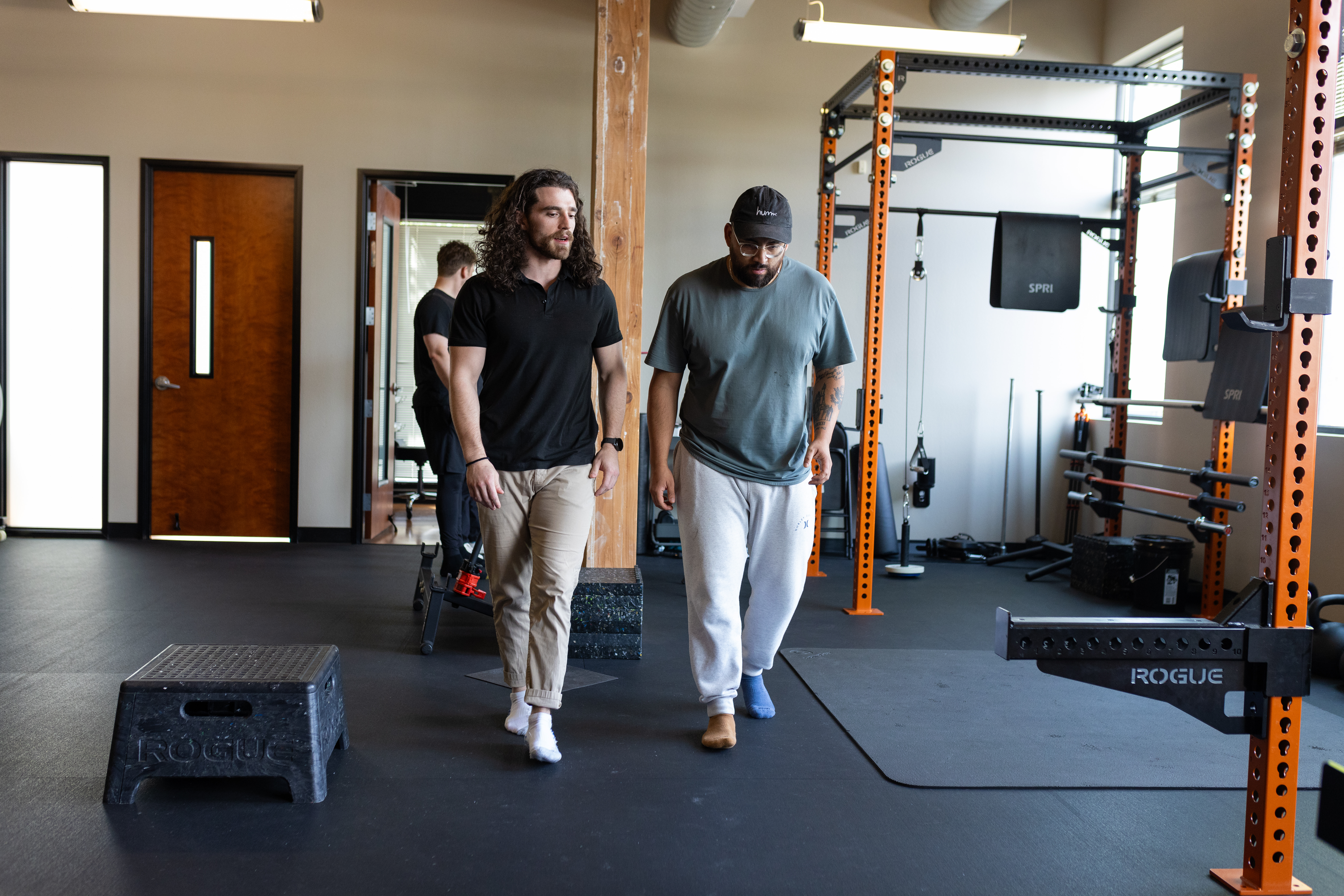
Why Your Plantar Fasciitis Involves More Than Just Your Foot
When someone walks in with pain at the bottom of their foot, we’re not only thinking about the plantar fascia. We’re thinking about how they’re loading their foot, what their foot mechanics look like, and how that ties up the kinetic chain through the hips and beyond.
Plantar fasciitis is generally an issue that develops gradually, based on how a person’s mechanics are working through movement and daily life. There are common patterns we see at Move Better — often around an old injury or instability in the ankle, people start loading their foot out of balance, which puts asymmetrical stress on the connective tissue, including the plantar fascia. That altered loading pattern, repeated thousands of times a day, is what eventually shows up as pain at the bottom of the foot.
What “Loading Out of Balance” Actually Looks Like
In practice, this often looks like loading the lateral side of the foot and not maintaining push off or extension through the big toe. That can be caused by — or cause — restriction in the joints of the big toe. We frequently see this gait pattern develop because of an unstable ankle: the body tries to stabilize by loading the lateral foot to keep the knee from collapsing in, which also points to an issue with creating external hip rotation.
The compensation pattern is to unload the knee by moving it out laterally, putting more weight on the lateral foot but losing the actual external rotation of the hip. That decreases the mobilization needed to stretch and move the plantar fascia and other intrinsic foot muscles, and it ends up overloading the lateral calf and peroneal muscles.
If the fascia and intrinsic foot muscles are not being mobilized as we load and walk they begin to stiffen and lose flexibility and the big toe ends up being a kind of hidden linchpin in the whole chain — and most people never think about their big toe when their foot hurts.
The Pain Isn’t Where the Problem Is
Honestly, the majority of the time the issue is not where the pain is. The pain is showing up in the area that’s taking on excessive stress because something else is not working properly. If we can figure out what’s not working properly and improve function, mobility, and strength to that area, that’s going to offload whatever tissues are being overstressed.
Pain is a signal to the brain telling us, hey — we’re overloading something, overstressing something. So we need to give the body another way to load or do that movement pattern, and move that stress to an area meant to manage it, where multiple muscle groups are functioning together rather than overstressing specific tissues.
Why Orthotics, Bracing, and Steroid Injections Often Make It Worse Long-Term
Conventional management of plantar fasciitis is generally orthotics, bracing, and cortisone shots. None of these are actually allowing the foot to work properly — if anything, they become a crutch that hinders it more.
The plantar fascia starts hurting when it gets really stiff and microtears in the tissue begin to develop. When you put a foot in an orthotic, that’s going to limit the movement and expansion of that tissue even more. In the immediate timeline, that can decrease pain and stress. But in the long run, that’s actually worsening the issue at hand.
What we need to do is improve the mobility of that tissue by improving how the structures connected to it are functioning. A big part of that is the calf muscle, the hamstrings, everything up the posterior chain. When you’re dealing with an acute phase, cushioning can be helpful short term — but we don’t want to perpetuate the problem by keeping that tissue from getting mobilized.
Our long-term goal is to get the foot working how the foot is meant to work. With that, the plantar fascia can expand and contract, all the intrinsic muscles can expand and contract, the arch of the foot works properly, and gait patterns promote healthier knees, healthier hips, and healthier backs.
The Eyebrows-to-Heel Connection
Here’s the piece most patients have never heard: anywhere along the posterior chain that’s restricted can add pull to the plantar fascia. That includes anterior head carriage — how someone is stabilized in their neck and upper back can lead to things like plantar fasciitis.
In the body we have planes of fascia — long continuous sheets. One of them runs down the posterior side of the body, starting from the eyebrows, wrapping around the top of the head, and traveling all the way down the neck, spine, and back of the legs into the plantar fascia at the bottom of the feet. It’s meant to move and stretch. But if we have areas of the body lacking mobility — or postural patterns that tighten it, like an anterior head carriage, or hips that aren’t hinging — all of that puts strain on this long connective chain of fascia. That stiffness then shows up in different places, and often starts to change the gait pattern in a way that further restricts mobility through the fascia at the bottom of the foot.
What Treatment Actually Looks Like
One patient we worked with had years of a really stiff Achilles with a thickened tendon — no specific injury, just stiffer and stiffer over time. That’s the pattern we often see, because they’re not stretching and moving through the tissue and foot properly, which continues to create further stasis.
On evaluation, she had quite a bit of limitation in big toe mobility on that same foot, especially into extension. Most of her loading was knee-dominant or low-back-dominant — she was not hinging through the hip at all to let the posterior chain move properly. Her gait pattern showed lateral loading, with matching wear patterns on the outside of her shoes, and a very stiff big toe.
Through treatment, we focused on improving hinge mobility with loaded hinging patterns to get the hips involved. We talked about keeping the big toe connected to the earth — most of these patients, when they fall into low back and knee dominance, rock back and overload their heels. So we worked on hip hinging and getting center of mass over the front of the foot, even if she couldn’t go as far into the hinge initially, just to slowly start mobilizing the tissue.
We saw her weekly, and also did a series of shockwave therapy sessions — shockwave helps break up scar tissue and stimulate the healing process in the chronic fibrotic tissue that had developed over time. By the sixth or seventh visit, we had a big increase in ankle and big toe mobility, much better higning and lifting mechanics — which also helped decrease her low back pain — and she has not had that ankle pain since. Years of it, gone.
Getting Out of Restrictive Shoes — Gradually
Part of long-term resolution is getting the foot back to working like a foot. That can look like spending some time walking around barefoot at home, using toe spreaders for portions of the day, and gradually getting into more minimalist shoes with wider toe boxes.
But we’re never going to have someone go from a really restricted shoe — or a strong orthotic — to suddenly walking barefoot all day. It’s a gradual process of listening to the body and how it’s responding.
For hiking boots specifically, the biggest thing is a good fit with a wide enough toe box and not too much heel, so the foot tissues have room to expand and contract to absorb shock and propel the body forward. Weight of the boot matters too — we generally prefer something lighter for longer hikes. Brands like Vivobarefoot and Merrell have some great options now with wider toe boxes. There are finally a lot more choices out there geared toward better foot mechanics.
If You’re a Runner Mid-Training
We understand sometimes people are going to choose to run through pain if they have been training for a big event. We have an honest conversation about goals. If it’s an event someone has qualified for and they’re going to do it regardless, we’ll work to support and manage the symptoms the best we can — without making them worse — until we get through the event, then go back to full rehab after the event.
In the interim, we might reduce mileage, strengthen surrounding tissues, and use shockwave around sessions (with about 48 hours off running afterward). Through rehab, we can touch on some running drills that help engage the hips more — that can be a pretty quick change in someone’s pattern that significantly unloads stress to the foot and calf. We don’t want to drastically change running mechanics too close to a big event, because that can affect both performance and create new discomforts.
Changing connective tissue mobility is a patient process. There’s a neuromuscular movement piece, but there’s also a tissue capacity and remodeling piece, which takes longer to respond. Shockwave can speed it up, however it still requires time for the tissues to fully heal and stabilize. The work we’re doing isn’t about masking the pain signal — it’s about resolving the reason your foot is sending it.
If you’ve been dealing with plantar fasciitis or nagging foot pain that won’t quit — or it keeps coming back every time you try to get more active — we’d love to take a look at the full picture. You can book with our team here.