Why Your Low Back Pain Keeps Coming Back — And the Movement Shift That Finally Changes It
You’ve stretched. You’ve iced. You’ve been adjusted, needled, massaged, and handed a list of exercises that helped for a week before the ache crept back in. If you’re starting to wonder whether this is just your life now, we want you to hear something clearly: your back isn’t broken. The way your body is stabilizing itself is what keeps feeding the pain — and that’s something we can change.
What’s Really Going On With Low Back Pain
Here’s the part most people never get explained to them. When you bend, lift, sit, stand, or hinge forward, your body has to stabilize your midline somehow. The question is how. Most people we see at Move Better are stabilizing by compressing the passive tissues of the low back — the discs, joints, vertebrae, and ligaments. It works. That’s the tricky part. It’s not a failure of the body; it’s a strategy that produces a real cost over time. Those passive tissues are slow to recover, and when you repeat this pattern hundreds of times a day, stress accumulates faster than your body can keep up with.
That’s also why imaging often doesn’t tell the full story. A disc bulge or some arthritis on an MRI isn’t necessarily the pain generator — it’s often a symptom of how the body has been loaded for years. We dig into this more in our piece on function over structure, and the Cleveland Clinic’s overview of low back pain backs up just how common — and how non-structural — most cases really are.
The Move Better Approach to Low Back Pain
The alternative pattern is something your body actually already knows how to do — it’s hardwired from infancy. It’s stabilizing the midline through intra-abdominal pressure: a coordinated contraction of the deep core musculature, led by the diaphragm. When this is working, the spine rests on muscular tension instead of compressing into passive structures. Your low back muscles can finally relax. We unpack the mechanics of this in our article on bracing for pain reduction and on belly breathing.
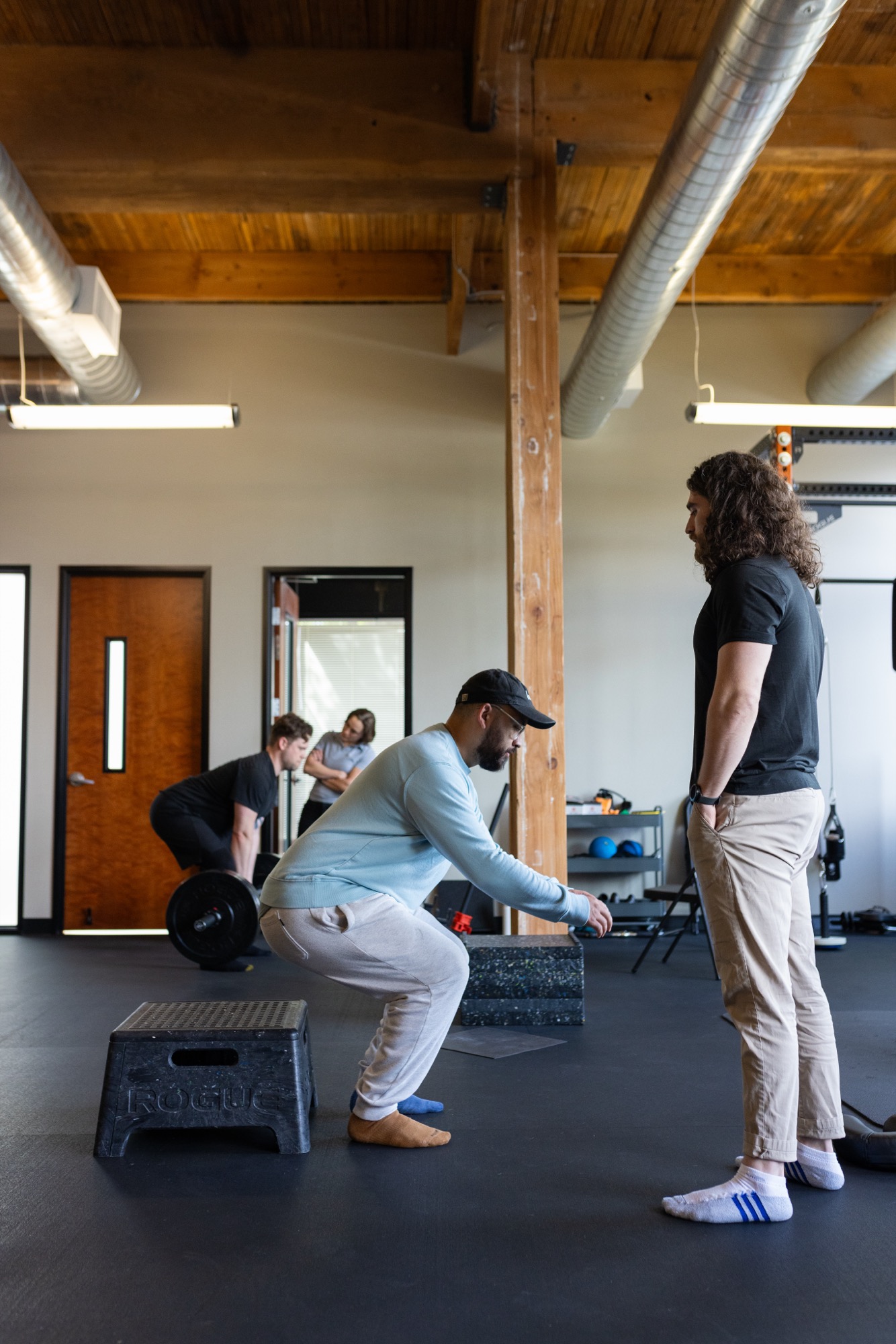
Our team uses Movement Paradigm Scoring to map exactly how you’re currently organizing your body, where the breakdowns are, and what specific patterns we need to retrain. This isn’t guessing. It’s a logic-based system, and the input-to-outcome path is predictable.
What Our Patients Experience
Your first visit is two hours. Not fifteen minutes. Two hours — with espresso or cacao in hand, in a space that doesn’t feel like a clinic — sitting with one of our doctors who actually has time to hear your story and show you, in real time, what we