What Actually Changes When You Run With Your Whole Body
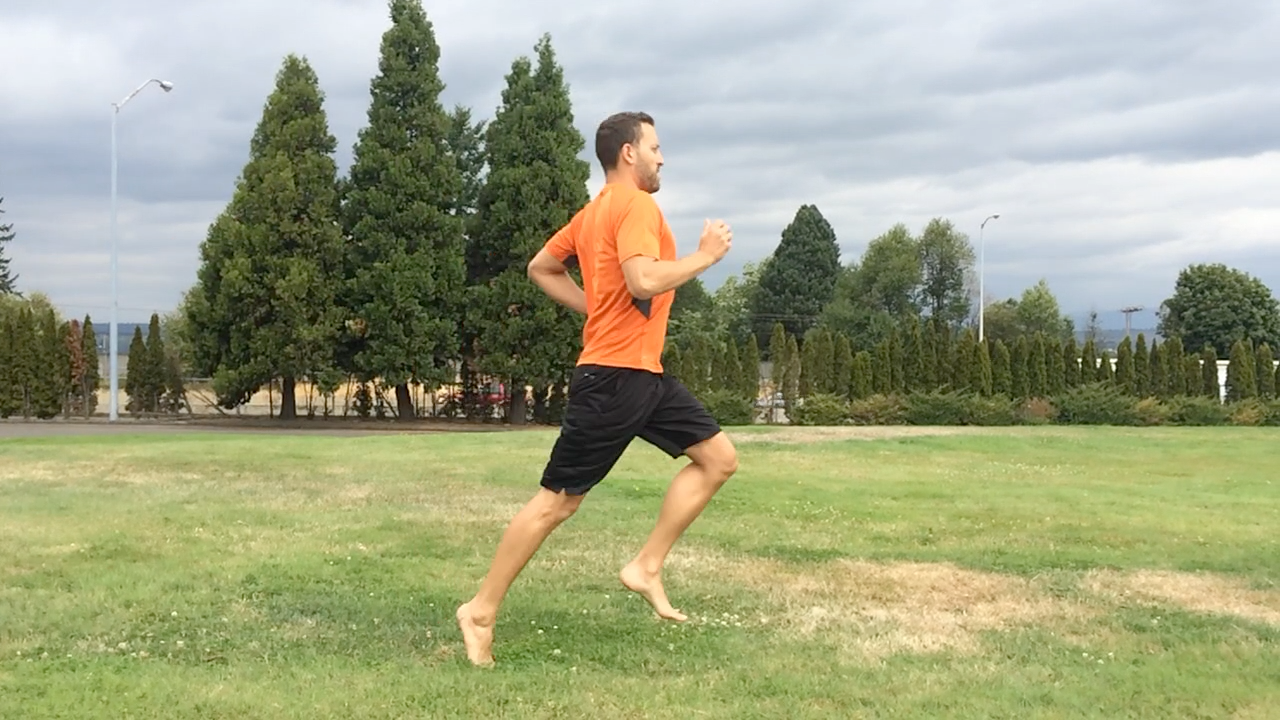
Most of you are too linear when you run. That’s the honest takeaway from spending an hour and a half watching four people loop a parking lot, then loading them up with strap work and barbell torque drills until the pattern showed itself. There’s no ability to navigate the stress of torque — to be twisted and anti-twist, or to create twist. Running becomes about the legs, and the rest of the body is just along for the ride.
I want to walk through what we actually did, because the through-line matters more than any single drill.
First Lap: What I’m Actually Watching
When I watch you run across a parking lot and back, I’m not looking at speed. I’m looking for where you’re getting your forward momentum from.
One runner was flicky in the feet — you could see the whole bottom of the foot as it came up. Another was too high and bouncy, prancey, way too springy. A third was rigid through the trunk, controlled to the point that nothing was actually rotating. And one — the seven-year-old, for what it’s worth — was just running. Free upper body. Everyone else was trying to run. She was running.
That’s the contrast I’m always pointing at. “It’s like almost too much control here — things are too rigid.” The body knows how to do this. Your job is to stop being in the way.
The Hip Push vs. The Knee Flick
The first correction for the flicky runner was simple. Stand on one leg, get the other leg up in the air, and let me resist you. When you try to push through with the knee, I can fight it easily. When you let the hip extend through — push from the butt — I can’t fight you. That’s a real difference.
You’re knee-flicking instead of hip-pushing. So try the hip push instead of the knee flick.
That’s phase one for almost everyone: just use your hips. Phase two is using the hamstrings to extend you through. Phase three is letting the pepper mill of your trunk be what runs you forward — the legs flowing underneath while the trunk drives.
The Hamstring Setup
I don’t usually talk about phase two on a first run, but here’s what it is. As you come through, the foot comes up toward the hip crease, and the hamstring sets you up for the next moment. The time your foot spends on the ground gets way shorter. Boom — then you’re off it and back.
To feel it: stand on one leg, hands on your hip creases, knees slightly bent. Reach back with the leg bone like you’re trying to hurt somebody with it. Don’t tilt. Don’t throw it. The trunk is the stable thing, and you’re reaching from the opposite muscles. That reach is what loads the psoas and iliacus — like loading a bowstring. If you arch or collapse, the rubber band has nothing to pull against. The bony edge of the pelvis acts like a fulcrum, and the muscle becomes a pulley over it. Lose the stable trunk, lose the stretch.
The Trunk Pump (And Why Your Hands Tell On You)
Here’s where most of you fell apart. As we’re running forward, the trunk has to rotate — there are two rubber bands loaded across the body. Butt to opposite shoulder. Hip to opposite shoulder. Both loaded, both ready to fire to the other side. That’s the pump.
If your arms are running like this — straight forward and back, no crossover, no give — there’s no pump. Sprinters’ hands cross midline. Their shoulders actually turn. The shirt and the pants stay parallel; the rotation happens through the trunk, not by tilting side to side.
When I told one runner to add the punch, he punched at 50%. I needed 10%. “It’s like you did running, you just went too far.” That’s what everybody does. You still have to be running. The trunk pump is seasoning, not the meal.
And there’s a counter-rotation reason for it. If I’m running hard and my hips are generating power, I have to counter-rotate the upper body or I’d spin like a helicopter without a rear propeller. My pump has to be equivalent to my hip power. If you came around the corner and ran into my hand, you’d get hit with the same force my hips are putting into the ground.
Why I Took Them Inside For Strap Work
After the parking lot, we came back in for cable and band work. Here’s why.
You can tell someone to rotate their trunk all day. They’ll do it with their shoulders, or they’ll arch their back, or they’ll tilt instead of turn. The strap penalizes those substitutions. You set up with a band wrapping from shoulder to opposite hip — your posterior oblique sling — and now you have to wind the coil from your big toe all the way up to your shoulder, then release it.
What we saw immediately: on the more able side, everyone could coil into the foot, schmear the earth a little, and release. On the less able side, the knee collapsed in, the coil stopped at the hip, and balance fell apart. That’s not a balance issue — vestibular balance is fine. It’s a control issue on that side. The body doesn’t know how to reach the ground with power.
This is the same pattern that was missing in the parking lot. The strap just makes it impossible to hide.
The Off-Center Deadlift
The last piece was the cleanest demonstration of the day. Take a barbell, put a 25 on one end and a 10 on the other, and deadlift it from the middle.
Your body doesn’t care about the weight. It cares about the torque. The heavy side wants to tip. The trunk has to push on one side while it pulls on the other. The slings have to manage uneven vectors at all times.
And here’s what good posture for a deadlift actually is — it’s the middle point between pushing and pulling. If I round my shoulders forward, I’m biased to push. If I pull my shoulder blades way back, I’m biased to pull. With an even barbell it doesn’t matter — you can pick it up however you want, there’s no torque trying to spin you. With this, there’s nothing to hide behind. You have to find the in-between or the bar drifts off your body.
You can do this with a shovel, a dowel rod with a kettlebell taped in the middle, a stick with plates on one end. It’s not about weight. It’s about effort. You can trick effort all day by biasing weight or lengthening the lever arm. A 25-pound plate two feet out from your hands generates torque that may as well be 200 pounds to your nervous system.
What I Want You To Take Home
If I had to pick one thing for each of you, I’d run with a single theme. Today, work the hamstring version — how do I get right here to work when I’m running? Next time, work the trunk — feeling the obliques and intercostals fatigue, not the legs.
The bigger principle, though, is the one we keep coming back to. Use your whole body to do the thing. Use your whole body to pick something up. Use your whole body to jump. Use your whole body to run. Most of the time when something hurts or stalls out, you’re trying to do it with one part of your body. Stop doing that. Use all of you. It gets easier.
That’s what the seminar is really about. Not a list of drills. A way of seeing what your body is doing, and where it’s quietly leaving energy on the table.
If you want to come do this in person — run, get watched, get loaded up, feel where the pattern actually lives — reserve your spot. It’s a real look at how I think about the body.
— Dr. Q, Move Better, Portland, OR