Sciatica in Portland: Why Your MRI Isn’t the Whole Story (and What Actually Helps)
You’ve been told you have a disc herniation. The report uses words like “severe” or “significant.” You’ve stopped riding, stopped running, stopped bending over to tie your shoes without bracing for the zing down your leg. Maybe surgery has even come up. If that’s where you are right now — we want you to take a breath, because there’s a lot more to your story than what showed up on that scan.
What’s Really Going On With Sciatica
Here’s something most people aren’t told clearly: the vast majority of patients who walk into our Portland clinic with an MRI-confirmed disc herniation make a full recovery with conservative, movement-based care. No surgery. No long-term medication.
The reason that’s possible comes down to a clinical truth that often gets lost: an image is a map, not the territory. Just because something shows up on your MRI doesn’t mean it’s the thing generating your pain. Most active adults over 30 have “findings” on imaging — bulges, mild herniations, facet changes — and walk around completely pain-free. Research from sources like the Cleveland Clinic consistently shows that imaging findings often correlate poorly with actual symptoms.
What’s usually driving your pain is some combination of acute inflammation, nerve sensitivity, and — most importantly — the movement and stabilization patterns that stressed those tissues in the first place. That’s the part that nobody fixes by handing you a prescription or pointing at a scan. It’s also the part that explains why structure isn’t the whole story when it comes to chronic pain.
The Move Better Approach to Sciatica
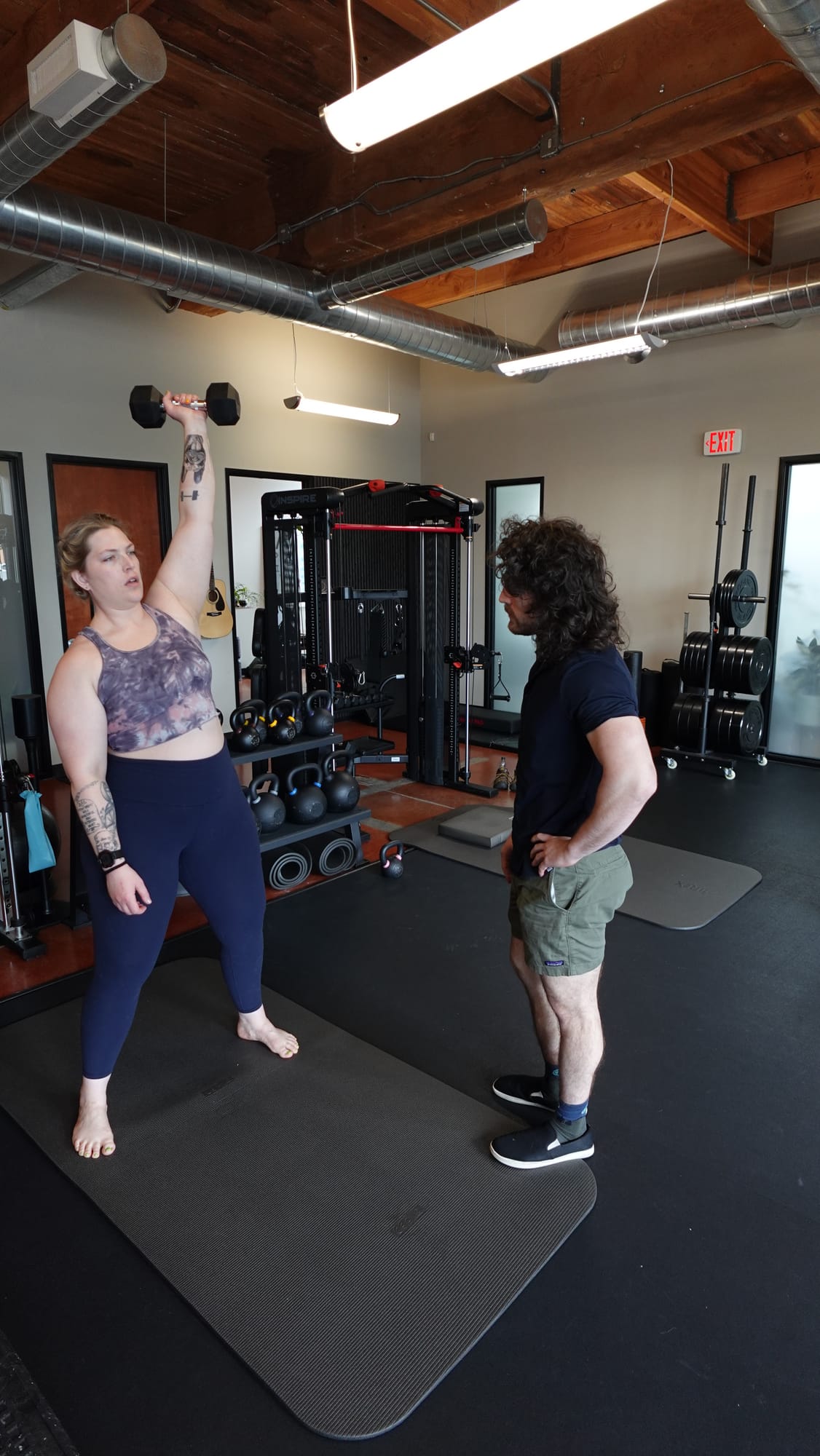
When you come in with sciatica, our team isn’t trying to “fix” the herniation. We’re trying to figure out what your body is doing that keeps loading that area in a way it can’t tolerate — and then teach it a better way.
That starts with our Movement Paradigm Scoring system, which is essentially a head-to-toe look at how your body actually moves and stabilizes. We assess:
- How you breathe (yes, really — your diaphragm has a massive role in spine stability)
- How you create intra-abdominal pressure to protect your low back
- How your pelvis positions itself standing, sitting, and hinging
- How your hip moves independently of your spine
- How your shoulder mobility affects pelvic stability (you’d be surprised)
We also use movement as a diagnostic tool. If bending forward provokes your sciatic symptoms, the disc is more likely involved. If pressing on your piriformis recreates that exact pain down your leg, we now have strong evidence your disc may not be the culprit at all — and your treatment plan looks completely different.
That distinction matters enormously, especially for our cyclists and trail runners.
What Our Patients Experience
Most people who come in scared leave their first visit with something they haven’t had in a while: clarity.
A common scenario: a cyclist arrives convinced their disc is destroyed. We lay them on their back and coach them through diaphragmatic breathing — just learning to expand into their low back on the inhale. Within minutes, their symptoms ease. Not because we “fixed” anything structurally, but because we changed the input their nervous system was receiving.
From there, we build. Visit by visit, we restore the patterns that were missing — pelvic control, hip dissociation, proper core bracing, and then progressively loaded movement that mimics what you actually want to get back to doing. Riding. Running. Picking up your kid without flinching.
This is not a 3-visits-a-week-forever situation. We’re trying to get you out of the clinic and back into your life with skills you can use for the rest of it.
The Insight Most People With Sciatica Are Missing
Here’s the one most people never hear: your “tight” glutes and piriformis might not actually be tight.
As one of our clinicians, Dr. Zachary Cullen, often explains — many cyclists and active adults develop a chronically tilted pelvis from hours in hip flexion (riding, sitting at a desk). That tilt puts the glutes and hamstrings into a position of constant stretch. They feel tight because they’re being pulled on all day — not because they need more stretching.
So if you’ve been religiously stretching your piriformis for months and getting nowhere — or worse — this is probably why. The fix isn’t more flexibility. It’s restoring pelvic position and teaching your body to stabilize from a neutral place. The same principle applies to a lot of chronic low back pain.
Research published through the NIH continues to support what we see clinically every week: addressing movement patterns and load tolerance outperforms passive treatments for most cases of sciatica.
Ready to Move Better?
If you’ve been carrying sciatica around for weeks, months, or years — and you’re tired of being told to rest, stretch more, or “just live with it” — we’d love to help you find the actual cause and a real path forward. Movement, done well, is one of the most powerful tools we have for sciatica. You’re not broken, and you’re very likely not headed for surgery. Come see us and let’s build you a plan that gets you back to the things that matter. Book a visit with our team here.
Move Better · Portland, OR