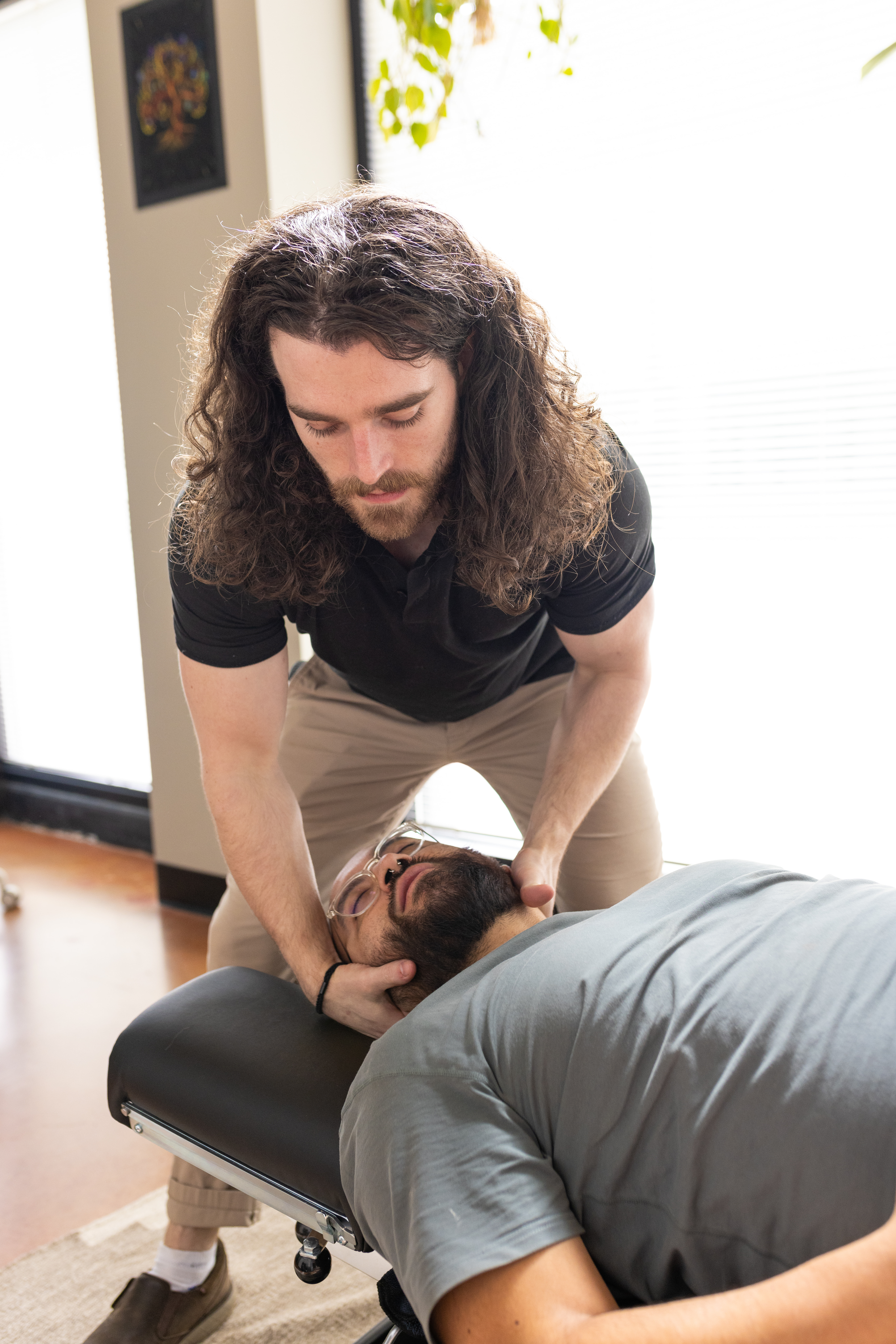
Neck Pain in Portland? Why the Fix Probably Isn’t in Your Neck
You’ve been stretching it. You’ve been massaging it. Maybe you’ve even had it cracked a few times. The neck pain calms down for a day or two, and then it’s right back — same spot, same stiffness, same nagging headache by 3pm. Sound familiar?
What’s Really Going On With Neck Pain
Here’s the thing most people (and honestly, a lot of providers) miss: your neck rarely acts alone. It sits on top of your thoracic spine — the middle part of your back, between your shoulder blades — and depends on that section being mobile to do its job well. When the thoracic spine gets stiff (hello, desk work, driving across the bridges, hours hunched over a phone), your neck is forced to pick up the slack. It ends up moving more than it was built to, day after day, and eventually it starts complaining.
That’s why generic “neck stretches” and repeated adjustments to the same cranky vertebrae often only buy you temporary relief. According to the Cleveland Clinic, neck pain is one of the most common musculoskeletal complaints — but the structures around the neck are usually a bigger part of the story than the neck itself. We dig into this idea more in our piece on function over structure: pain is rarely about one “broken” part. It’s about how the whole system is moving — or not moving — together.
The Move Better Approach to Neck Pain
At Move Better, we treat the neck as a symptom site, not the source. When you come in, we’re not just poking around your neck and calling it a day. We look at the whole spine — and honestly, the whole body.
Our process starts with watching you move. We’ll watch you walk, screen your lower back and your thoracic spine, and use our Movement Paradigm Scoring system to identify where your movement options are limited. Pain isn’t a “wrong movement” — it’s usually a sign that your body is running out of good options and is leaning on the same overworked structures over and over.
From there, we get to work on the area that’s almost always the real culprit: your thoracic spine. When we restore mobility through the mid-back, the neck finally gets to do its own job again instead of compensating for everything below it. In a lot of cases, we never have to do hands-on work directly on the painful neck itself — and patients are genuinely surprised by how quickly things shift.
What Our Patients Experience
Most of our patients walk in expecting us to zero in on the part that hurts. So when we spend the first session assessing how their whole body moves — and then start treatment in their mid-back — there’s almost always a moment of “wait, that’s where the problem is?”
Then they stand up. They turn their head. And it moves further, more freely, with less pain than it has in months.
That’s not magic — that’s mechanics. When the thoracic spine starts contributing the way it’s supposed to, the neck stops being the workhorse for movement it was never designed to handle alone. From there, we build you a plan to keep it that way: targeted mobility work, strength where you need it, and an understanding of why this happened so it doesn’t keep coming back. If you want to go deeper, we wrote more about this in our article on combatting chronic neck pain.
And — important — you’re not going to be on the hook for three visits a week forever. We’re aiming to get you better and teach you the skills to stay better. That’s the whole point.
The Insight Most People With Neck Pain Are Missing
As one of our clinicians, Dr. Zachary Cullen, puts it: the neck is almost never working in isolation. If your thoracic spine is locked up — and for most desk workers, drivers, and parents hauling kids around, it is — your neck has been quietly compensating for a long time before it finally spoke up.
That’s why repeatedly treating the neck without addressing the rest of the spine tends to give you short windows of relief followed by the same pain. The neck isn’t the problem to solve. It’s the messenger telling you something upstream needs attention. Once you address the real source, the neck calms down — often faster than you’d expect.
Ready to Move Better?
If you’ve been chasing neck pain in circles, we’d love to help you connect the dots. Our team takes the time to look at the whole picture, build you a real plan with a real endpoint, and teach you how to keep moving well for the long haul. You can book a visit with us at Move Better whenever you’re ready — and if you’d like to meet the people you’ll be working with first, our team page is a great place to start. Your neck doesn’t have to be the loudest part of your day.
Move Better · Portland, OR